What the Dandelions Knew
Some pieces reveal themselves while I am making them. Others seem to know something before I do.
This was one of those pieces.
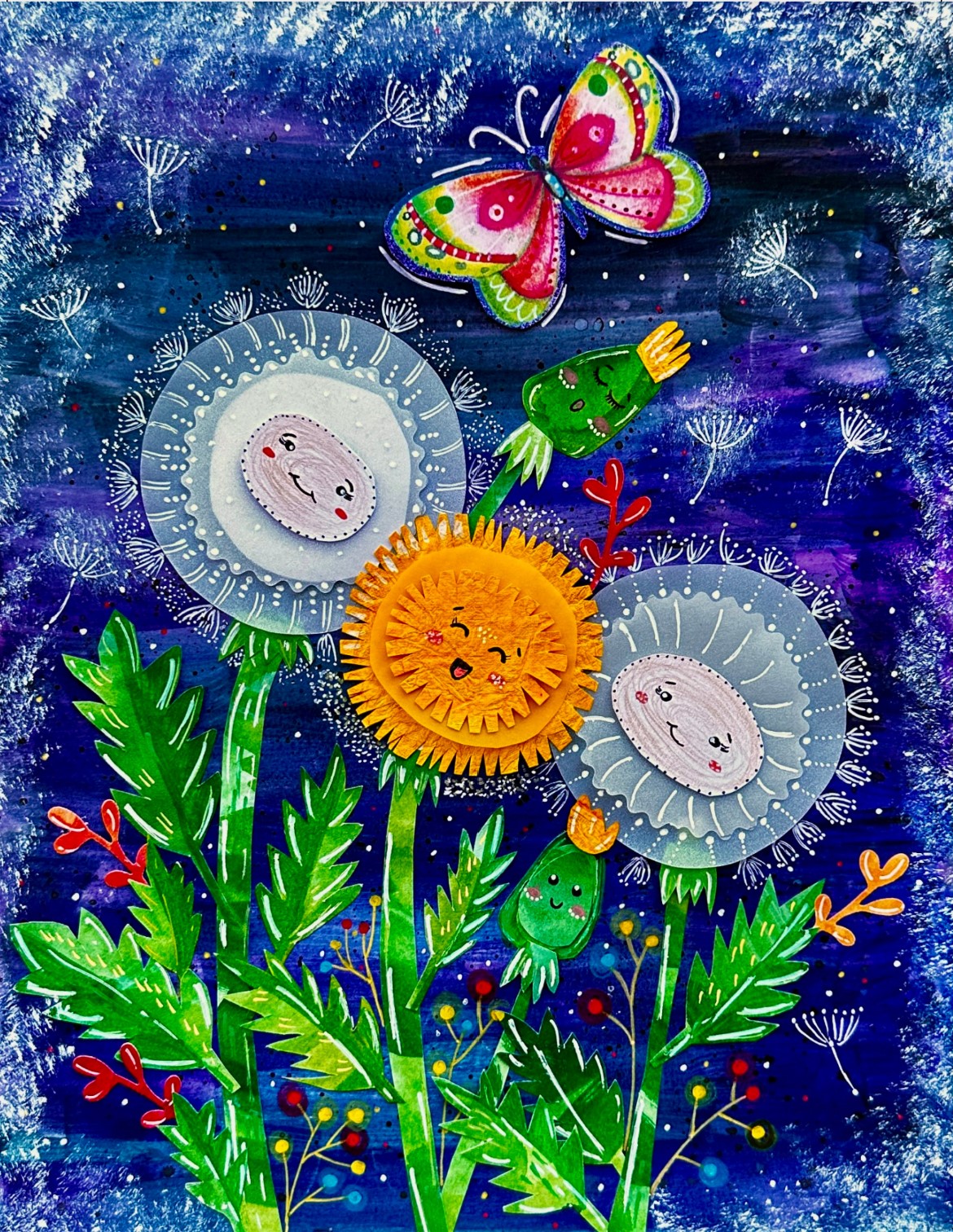
When I created it, I thought I was making something bright: a yellow dandelion with a smiling face, two seed heads beside it, a butterfly overhead, a tiny crowned green figure among the stems, and white seeds drifting into a dark, star-filled sky.
I was not trying to make a statement about illness or resilience. I was simply making something cheerful during a time in my life that was anything but. Years later, I see something in it that I could not have understood then.
Dandelions are strange things. We dismiss them as weeds, yet they grow almost anywhere. They push through cracks, return after being cut down, and survive in places that seem inhospitable to anything delicate. But it is not their resilience that affects me most anymore. It is what happens when they are finished blooming.
They let go.
The seeds rise into the air without direction or certainty. The flower cannot decide where they will land. It cannot follow them. It cannot know whether they will be safe.
As a parent, that idea reaches somewhere painful in me. When your child is gravely ill, you want certainty more than almost anything. You want to understand every result, notice every symptom, ask every question and stay one step ahead of whatever might happen next. You begin to believe that enough vigilance might protect you from being blindsided.
Around the time of my son’s initial diagnosis, I read Joan Didion’s “The Year of Magical Thinking”. What stayed with me was not a particular passage, but the way she described the mind circling unbearable circumstances, returning to the same facts again and again as though understanding them completely might somehow change them. Fear has its own rituals.
When your child is sick, the mind begins making private bargains. Maybe if I noticed sooner. Maybe if I had asked one more question.
Maybe if I never stop watching. Maybe if I stay afraid enough, I will be ready. I knew, logically, that fear could not control what happened. But logic was not the part of me living through those days. Fear wanted rules. It wanted cause and effect. It wanted to believe that vigilance could keep disaster outside the door. And eventually, worry can begin to disguise itself as love.
You keep watching because not watching feels dangerous. You keep worrying because relaxing starts to feel irresponsible. Sometimes even relief makes you uneasy, as though letting your guard down means you have stopped protecting your child. As though fear itself is doing something. As though staying terrified might keep them safe.
That is what I understand differently now when I look at the floating seeds. The release is not peaceful to me. It is not some beautiful lesson about surrender. During illness, letting go feels nothing like that. You let your child go into scans, treatments, appointments and rooms where you cannot always follow. You wait outside doors. You wait for phone calls. You wait for numbers. You wait for someone else to tell you what is happening inside the person you love most.
There is nothing gentle about it. I think that is why this piece has changed for me. I once saw a cheerful little scene. Now I see a confrontation with how little control love actually gives us.
We can protect. We can prepare. We can ask questions. We can advocate. We can hold on fiercely. But there are places love cannot follow. That was the part I resisted most. I wanted parenthood to mean keeping everything safe and close.
I wanted love to be useful in that way. I wanted it to prevent. Instead, I learned that love and control are not the same thing. The small crowned creature in the piece feels almost absurd to me now, smiling beneath that enormous swirling sky.
But perhaps that is why I still love it.
Life does not become entirely solemn just because something terrible is happening. There are still strange moments of humour. Imagination. Colour. Beauty arriving at inappropriate times. The butterfly feels that way too. It is simply passing through. It does not belong to the dandelions. It cannot be made to stay. And yet its brief presence matters.
Maybe that is what the whole piece understands better than I did. Not everything meaningful can be kept. Not everything beautiful stays. And survival does not always look like triumph.
Sometimes it is simply the fact that something is still here. Still growing. Still finding colour in the dark. I do not think I have made peace with uncertainty. I am not sure I ever completely will. But when I look at this piece now, I see a version of myself beginning to understand something I had spent years resisting: Love can be immeasurably deep without giving us the power to control what happens to the people we love.
And perhaps that is what the dandelions knew all along.
Leave a Reply