The Jar I Could Not Keep Closed
This piece began with a song.
I had always known Van Gogh’s Starry Night. I knew the blue, the movement, the sky that looks alive and unsettled, the kind of beauty that does not feel calm. But when I made this piece, I was thinking just as much about Don McLean’s Vincent.
When my son was ill, that song broke me open. I could not hear it casually. It was not background music to me. If it came on, something in my body changed. Warm tears would stream down instantly, not because of one specific line or one clear thought, but because the song seemed to touch the part of grief I was trying so hard to contain. It made sadness feel enormous. It made beauty feel almost unbearable.
That is the feeling inside this piece.
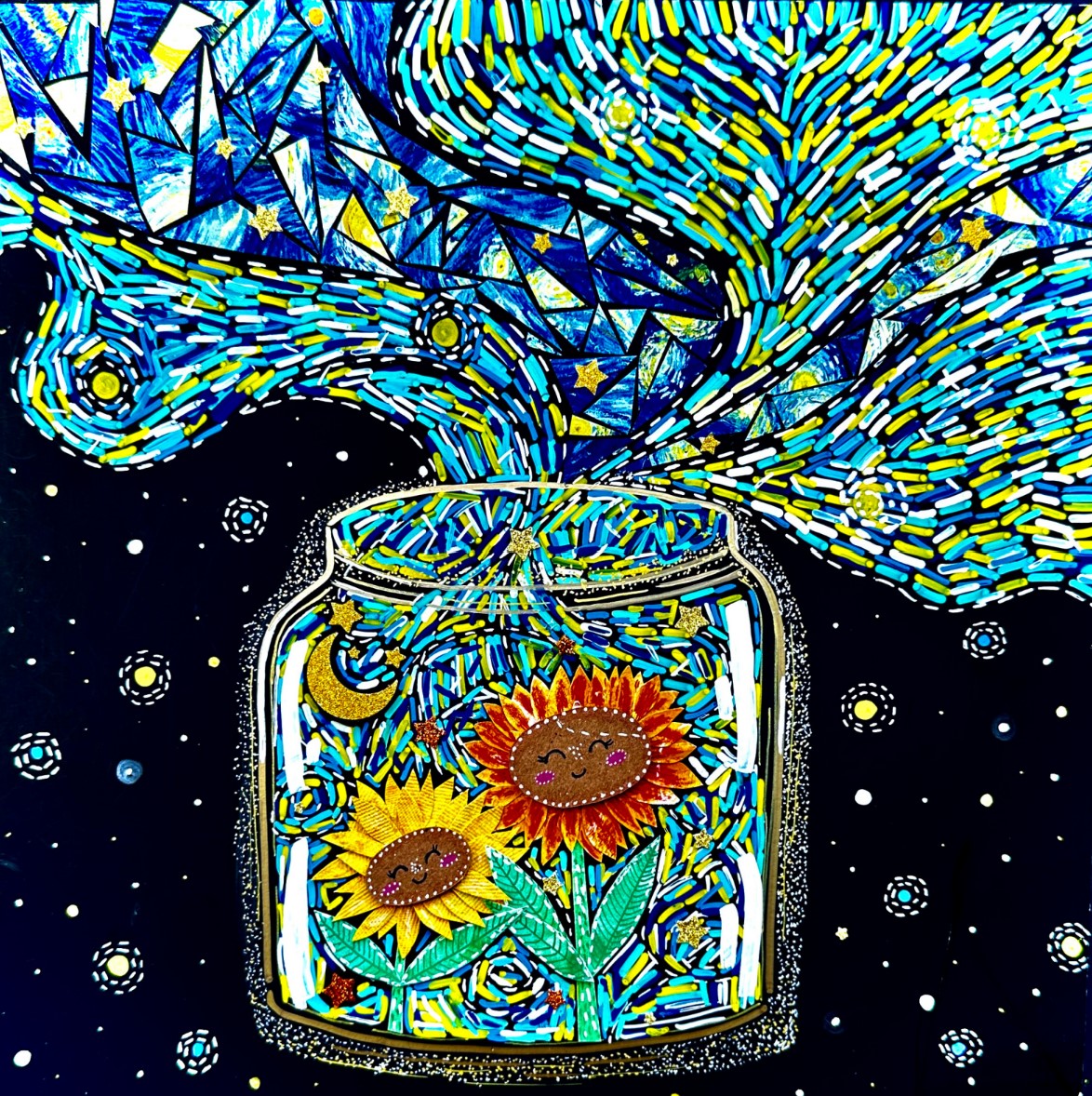
There are two sunflowers in a glass jar. They are bright, smiling, almost sweet. Around them, the sky moves in thick lines of blue, yellow, white, and black. It is full of stars, motion, and noise. The outside world feels restless. The flowers are the only still thing.
Those two sunflowers are my children.
I placed them inside the jar because that was what I wanted to do in real life. I wanted to gather them into one protected place. I wanted to put something clear and solid around them. I wanted to separate them from cancer, from fear, from adults whispering, from hospital rooms, from waiting, from the heaviness that entered our family and changed the air around us.
I wanted the jar to work. That is the part of this piece that hurts me most now. The wish inside it is so obvious to me. I was trying to create a small world where they could stay untouched. But there was no untouched place. Illness does not only happen to the person who is sick. It moves through the whole family. It changes the rooms in the house. It changes the way siblings look at each other. It changes what a normal day feels like. It changes the parents too, even when they are trying very hard not to let that show.
The jar looks protective, but it is also fragile. It can hold the flowers, but it cannot make the sky disappear. It cannot stop the movement around them. It cannot erase what they have already seen. Glass gives the illusion of safety, but it does not make the world outside less real.
That was parenthood during my son’s illness. We could bring snacks, blankets, toys, and distractions. We could sit beside hospital beds and try to keep our voices steady. We could organize, remember, advocate, pack, unpack, answer questions, and pretend we were functioning better than we were.
But we could not put our children inside a jar. We could not seal the fear out. That was the helplessness I did not know what to do with. As parents, you are supposed to protect your children. That instinct is almost physical. It lives in the chest, in the hands, in the way you watch everything. But cancer made protection complicated. It forced us to learn that love could be enormous, unmeasured, and infinite, and still not be able to stop what was happening. That truth felt cruel.
In the piece, the flowers are still smiling. I remember making them that way. I think part of me needed them to be okay somewhere, even if only on paper. The sky could move around them. The dark could press close. The stars could scatter. But inside the jar, I could make them bright. That is what art allowed me to do. Not fix anything. Not change the diagnosis. Not control the outcome. But create one small place where my children could remain untouched for a moment.
The sky around them is beautiful, but in my eyes, it is not peaceful. It has too much movement. Too many lines. Too much happening at once. That feels honest to the way life felt then. Even when the house was quiet, nothing inside me was quiet. There was always the next result, the next symptom, the next appointment, the next thing that could go wrong.
And then there was the song. Vincent gave shape to a kind of sorrow I could not explain. It made me think about how beauty and pain can sit so close together that they almost become the same thing. That was what my life felt like then. I was surrounded by ordinary beauty — my children’s faces, their voices, their small routines — and yet everything was threaded with dread.
That is what I see in this piece now.Not just sunflowers. Not just stars. Not just a jar. I see two children placed somewhere bright because I needed to imagine them safe. I see a storm I could not stop. I see the limits of love, which is still one of the hardest things for me to write about.
I no longer have the original piece. I sold it to a very dear mother who lost her own daughter to cancer. There are some pieces that are hard to let go of, not because you regret selling them, but because they leave with a part of your own story still attached. This was one of them.
But when she wanted it, something in me understood. I could not imagine it belonging to anyone else. She saw something in it that was her own. Her interpretation was not exactly mine, and I think that is part of what made it so meaningful. The piece had begun as my attempt to place my children inside a fragile kind of safety. In her hands, it became connected to her daughter, her grief, her memory, and her own way of understanding love after loss. That is one of the most powerful things about art. You make it from one place inside yourself, but once it leaves you, it can become a vessel for someone else’s story too.
I think about that often with this piece. I made it while trying to protect life from illness. It now lives with someone who knows, in the deepest way, what illness can take. And somehow, that feels painfully right. Because this piece was never only about protection. It was about the ache of wanting protection to be possible. It was about the impossible wish that love could become glass, that devotion could become a wall, that fear could be kept outside if only we held everything carefully enough.
But love is not always a shield. Sometimes it is the thing that remains when the shield fails. That is what this piece holds for me. Not a perfect shelter. Not a promise that everything outside can be kept away. Something more painful than that, and more honest. A jar filled with light. A sky that will not calm down. Two flowers I loved more than my own life. And the truth I was not ready to accept: that even the deepest love cannot always keep the glass from shaking.
Leave a Reply