The Whale That Carried My World
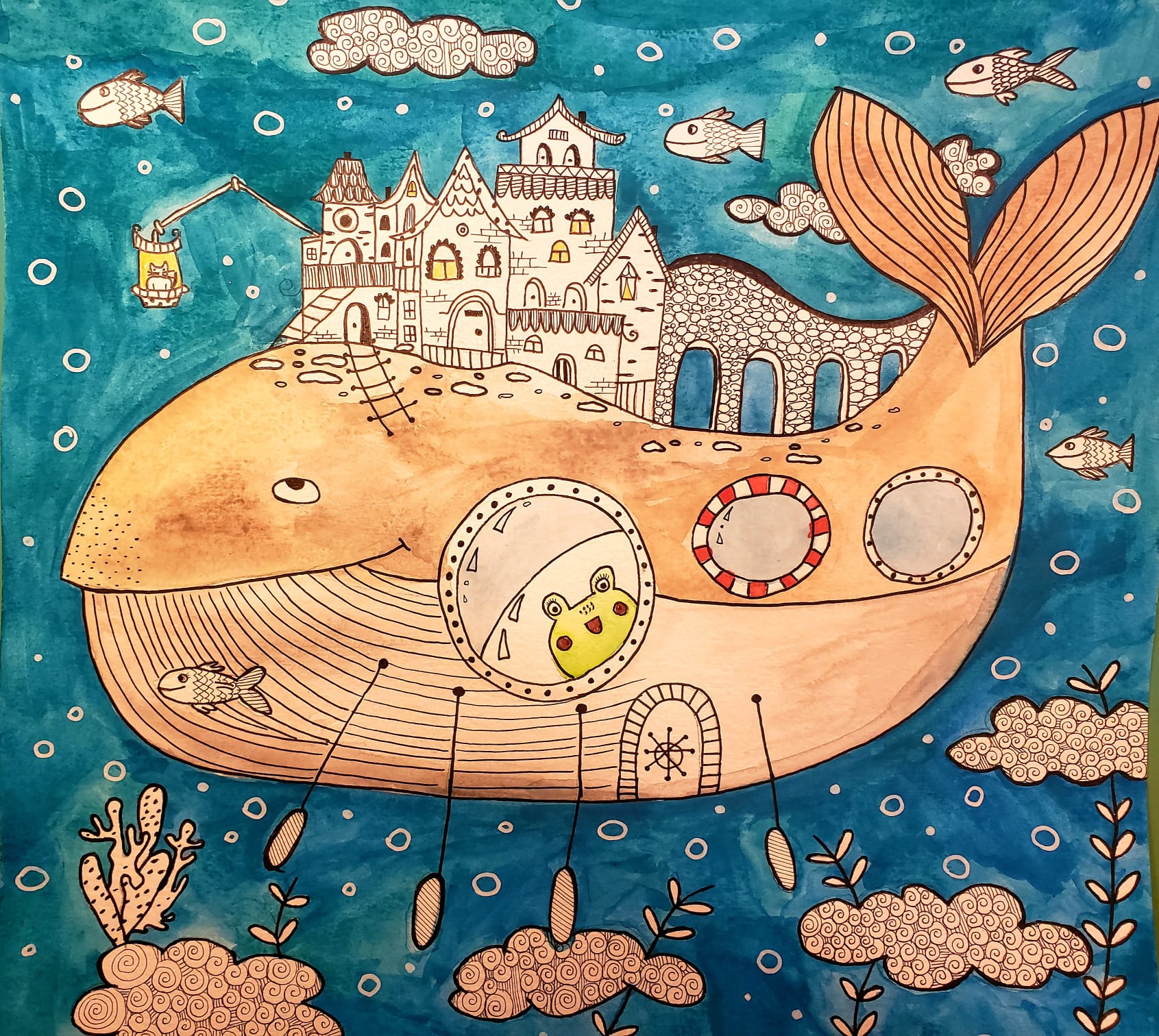
Art has a strange way of telling the truth before we are ready to understand it. For years, I thought this piece was simply a whale carrying a village on its back. I saw the soft blues, the floating clouds, the tiny fish, the glowing windows, and the quiet underwater world. I saw something whimsical, almost childlike. It was only much later that I understood what it had been holding.
I created this whale during my son’s cancer relapse, one of the darkest periods of my life. At the time, my world had narrowed into hospitals, scans, waiting rooms, bloodwork, and the terrifying belief that I might lose him. Ordinary life became secondary to the next appointment, the next result, the next conversation, and the next fear.
When you are living inside something catastrophic, you do not stop to interpret it. You answer the phone, pack the hospital bag, listen to doctors, watch your child, and try to stay calm. You become useful because usefulness gives terror somewhere to go.
Somewhere inside that fear, this whale appeared.
I was not trying to make a piece about cancer or grief. I was trying to create something beautiful while living through something unbearable. That may be why the piece hurts me now. It is soft because my life was not. It is whimsical because reality had become too frightening to look at directly.
The whale carries an entire world on its back. Fragile homes are stacked together like memories, responsibilities, and the people I was desperately trying to hold onto. The tiny glowing windows feel especially meaningful to me now. They look warm, but distant, like reminders that life was still continuing somewhere while ours had stopped. The whale itself feels exhausted. It is not dramatic or frantic. It is simply heavy, slow-moving, and submerged beneath an endless blue that feels less like water than isolation. In its body, I can see the shape of what I was holding: my child’s suffering, the medical details, the hope, the dread, and the impossible responsibility of trying to stay steady while everything inside me was breaking.
And yet, I softened the world around it. I added tiny fish, drifting bubbles, rounded lines, delicate clouds, little lanterns, and small signs of life. I think I was trying to create a place where fear could exist without destroying everything around it, a place where grief could be held gently because I could not hold it any other way.
At the time, I thought I was making an escape: a fantasy world, a whale drifting through a dreamlike sea. Now I see something else. I was painting what it felt like to carry too much and keep moving anyway.
The detail that affects me most now is the tiny frog peering through one of the windows. It is easy to miss because it is so small compared to the whale, but emotionally, it has become the center of the piece. The frog is protected, but isolated. Present, but powerless. Watching the world from behind glass.
I do not remember giving the frog any larger meaning when I made it. But looking at it now, I think it became the most vulnerable part of me without my realizing it. While the whale bore the weight, the frog witnessed.
That is what happened to me during that time. My own inner self became secondary to survival. There was very little room for me as a person. I became my son’s mother, his caregiver, his advocate, and the keeper of appointments, medications, scan dates, symptoms, questions, and fears. Every part of me had a job: watch, protect, anticipate, endure.
And somewhere inside all of that, there was still a small part of me looking out from behind the glass. Quiet. Overwhelmed. Still there.
I understood this only later, when I began processing what had actually happened to us. At the time, there had been no space to feel the full weight of it. There was only the next thing to manage, the next fear to swallow, the next moment that required me to hold myself together. But afterward, when I looked back at this piece, I could see that my hands had been telling the truth long before I had the language for it.
That is when I began seeing the whale differently. Not as a sweet piece of fantasy art, but as a record of a version of myself who was carrying more than she could say.
It was grief translated into gentleness because the rawness of the pain itself was too overwhelming to face directly. It was my mind and my hands finding a way to tell the truth without saying it plainly.
The whale carried the world. The frog carried the part of me I almost lost inside it.
For years, I thought I had made a gentle whale. Now I see a mother. I see the weight, the fear, and the tenderness I was still trying to create inside the devastation. Even when I could not name what was happening to me, some part of me was leaving evidence behind.
The whale does not escape the water. It does not become lighter. It does not put the village down. It simply keeps moving with everything it carries.
This piece was never about disappearing into another world. It was about remaining inside this one, even when it felt unbearable, and finding a way to keep what I loved safe.
The whale was not an escape.
It was survival, made gentle enough for me to look at.
Leave a Reply